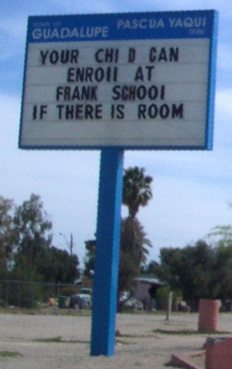
|
|
Charter Schools
"We have seen charter school applicants in the suburbs and downstate denied time after time."
|
What IS a Charter School?
A charter school is a public school that has been developed
to serve a particular mission. Often, a charter school
is started by a group of parents who are seeking an alternative
to other existing schools in an area.
It's important to emphasize the extraordinary variety of approaches
used by charter schools! Some charters are designed around missions
that are highly focused (such as on art, or with a particular ethnic emphasis)
and in some cases these wind up being fairly shallow in traditional academics.
Other charters have heavy emphasis on building a foundation
of knowledge for later learning, with rich academic content.
Some charters use the most extreme progressivist teaching methods,
others use structured teacher-centered strategies.
In other words, be careful never to lump them together
(or trust reports that lump them together)!
-
Illinois Network of Charter Schools (INCS): Organization that helps to network and provide
mutual support for charters in the city of Chicago. However, despite the word "Illinois" in its name,
it has devoted little action in the cause of expanding charters statewide. The organization
has also not shied away from proclaiming the political learnings of its executive staff.
-
ISBE (the state education bureaucracy) website on charter schools in Illinois
- ISBE's
ISBE 2007 Annual Report on Charter Schools
-
"How Much is Tuition?": Charter Schools Defined
by Terrence Moore, Ph.D., September 2006.
"Charter schools are among the least understood public institutions
around, perhaps even less understood than the bolder form of school
reform known as vouchers. ...
"Far from being private schools, charter schools are public
institutions. ... Charter schools have been defined as 'independent
public schools of choice, freed from rules but accountable for
results.' Charter schools are independent in the sense that they do
not report to school boards in matters of hiring, curriculum,
administration, or governance. In fact, most charter schools have
very little interaction with their districts except when certain
state reports are due or standardized tests are being administered,
in short, when certain state-mandated functions are being coordinated
at the district level. Almost all decisions made in a charter school
are 'site-based' as the lingo goes now. Though mostly autonomous,
charter schools are nonetheless public because their revenue comes
from public taxes and they are open to the public. ...
"Charter schools are also more accountable for their results than are
regular public schools. Charter schools are accountable principally
in two ways. First, they are required to take the same standardized
tests that all other public schools must take. ...
Second, the element of choice also makes charter schools accountable.
If parents do not like the education their children are getting, they
are free to take their children out of the school. ... A school of
choice with a declining enrollment has no option but to change or,
eventually, to go under. Without choice, [conventional public] schools are
accountable to no such pressures. They stay in business forever,
whether they are successfully teaching students or not. ...
"Opponents of charter schools ...
are monopolists. They want regular public schools protected from
competition at all costs. I suppose there is an argument for
monopoly, but we must wonder whether critics of monopoly would
practice what they preach in other matters in which we take choice
for granted. Do the critics of charter schools wish to be forced to
buy Fords simply because Ford has fallen on hard times and could use
the business or be required to buy HP computers though they might
prefer Apple or Dell? If they go to church, do they wish to pay
tithes to the church located closest to their house, though it is
Catholic and they are Protestants? What if they do not go to church?
If they live in Fort Collins, Colorado would they agree in all cases
to send their children to C.S.U. and not to U.N.C. or to Colorado
College or to The Citadel or to M.I.T.? Would these public-school
apologists as parents agree to have their children go only to the
closest pediatrician or dentist? Might they agree to being Denver
Broncos fans even if they grew up in Pittsburgh or Dallas?"
Notes About Charter Schools
- When Failure Means Success,
editorial, Chicago Tribune, April 1, 2002.
"A charter school failed in Chicago last week. But its ordered closure by the
Chicago Public Schools board only demonstrates how well the charter model works. ...
In Chicago, it's simple. You don't perform, you don't survive. ...
A study just released by the Chicago Public Schools helps explain why. All but
two of Chicago's charter schools are outperforming their neighborhood public
schools on nearly every one of 70 different measures--from reading and math
scores to attendance to dropout rates. The most glaring exception was [the charter that wass just closed].
In fact, by some measures, several Chicago charters are seriously outperforming
neighborhood schools. At the three elementary campuses of Chicago International
charter schools, for example, math scores are off the charts compared with the
neighborhood schools the kids likely would attend if the charter didn't exist.
Officials there suggest it may have to do with the
Saxon Math program used at all
its schools."
-
Charter School Nonsense --
Wall Street Journal editorial, August 28, 2006.
"All charters aren't successful, but the bad ones tend to close in due course,
which is a good thing and more than can be said for failing traditional public
schools. As for the rest, they are providing a fast-growing option for
underprivileged children. This irks unions, school boards and others with a
vested interest in a public school monopoly that's failing to educate millions of
kids. But it doesn't mean the Bush administration has to give its political
opponents fodder in the form of shoddy, oversold research on school performance."
-
Gaffes Spell Doom: Students' Sloppy Letters Aid Charter Schools' Approval
by Kevin Rothstein, Boston Herald, February 25, 2004. Excerpt:
"All the proof state Board of Education member Roberta Schaefer needed
to OK controversial new charter schools were the letters before her
from public school students.
Schaefer ridiculed the letters against a proposed school in Marlboro
for their missing punctuation and sloppy spelling -- including a
misspelling of the word 'school' in one missive.
'If I didn't think a charter school was necessary, these letters have
convinced me the high school was not doing an adequate job in
teaching English language arts,' Schaefer said."
|
"Charter schools improve a neighborhood's
quality of life mainly because [their residents] have a choice."
-- a Realtor®
|
-
Charter Schools: Are They Reinvigorating Public Education?
Parents, neighborhoods and new developments are gaining choices when
it comes to educational opportunities for their children
by Jason Miller, in Public Schools: A Toolkit for Realtors, National Association of Realtors.
"The benefits spread to charter schools' immediate communities, too,
says Vicki Cox Golder, CRB, a REALTOR® with Vicki Cox & Associates in
Tucson, Ariz., and a former school board chair and Governor's
Education Task Force member.'Charter schools improve a neighborhood's
quality of life mainly because [their residents] have a choice. If
parents are given a choice that's affordable for them, that improves
the quality of life in a community.'"
- Some school districts have complained that the opening of charter schools
"cost them money." In such cases, it's far more likely that bogus or incompetent fiscal projections
by the district itself are at fault. Read this:
Charter Schools and District Budgets
by James Fedako, June 30, 2005. Excerpt:
"The only result of more or fewer students than estimated is actual
revenue that is either more or less than estimated. The key word
here is estimated. A fundamental task of the school budget process,
and one of the primary jobs of a district accounting office and local
board, is estimating next year's student count. School districts in
Ohio know -- and have known for ages -- that they face stiff competition
from other education providers (charters for sure but also home
schooling, virtual schooling, and private schooling). While they wail
to the press about these pressures, districts continue to make
enrollment projections that pretend that charters don't exist, or
aren't the popular alternative they are, and they continue to
overestimate district enrollment. That's not the fault of charter
schools. It's the fault of naïve enrollment projections from people
who ought to know better."
-
Charter Schools Grow Up (PDF)
by David Dodenhoff,
Wisconsin Interest, 2001, Vol. 10 No. 1
Charter Schools Are NOT All the Same!
The whole point of having a charter school is to provide
a opportunity for an education option that is different from the one offered by other public schools.
It should come as no surprise, then, that charter schools are different from each other as well. Read on ...
- "First, charters are not in themselves a reform strategy; they are a blank slate.
They are simply an opportunity to try something new, and they run the gamut from alternative
schools for inner-city dropouts and incarcerated teens to International Baccalaureate
academies in posh suburbs. A welter of studies has laid claims to both the superiority of charters and
their inferiority, but we don't learn much from that. To discuss their effectiveness as a group
means about as much as trying to evaluate whether restaurants, as a group, are good.
Some are wonderful, some dreadful, some have shut down and some probably ought to."
-- Jonathan Schorr, author and high school program director for the KIPP Foundation, Washington Post, September 11, 2005.
-
Playing to Type? (PDF)
by Dick Carpenter, University of Colorado at Colorado Springs, October 6, 2005.
What does the phrase "charter school" convey? Besides some basic information about
structure, governance, and accountability, what does the word "charter" tell us
about the curriculum, pedagogy, and theory of learning of the roughly charter 3,500 schools?
Not a heckuva lot. To fill the void of information, Dick Carpenter has fashioned a typology of
charter schools -- one that distinguishes between a giant lump of "charters" and 3,500 completely unique institutions.
Some of his key points are:
- "That a school operates under a charter
may be the least important thing about it."
- "Charters are not the undifferentiated mass
imagined by many researchers."
- "NCLB encourages school districts to convert
underperforming, traditional public schools into charters,
but this policy assumes that charter status will improve performance
regardless of the educational approach employed."
- "Some of the highest performing schools in a given community are
charter schools, but so are some of the worst performing."
- Contrary to expectations of many, there are more progressivist charter schools (29%)
than traditionalist/back-to-basics charter schools (23%). The single largest grouping
identified by Carpenter is "general" (30%) with no clearly identified educational philosophy.
- In an effort to identify and recognize charter schools devoted to substantive content
and classic liberal learning, the American Academy for Liberal Education has started a
"Charter School Accreditation Program."
You can find out more about the program,
and the first lists of schools it has accredited, at the linked website.
-
Seeking a 'Gold Standard' in DC Charter Education
by Jay Mathews, Washington Post, November 19, 2007.
"In the charter school movement's endless quest to recruit students,
some of the best independent public schools support each other by
word of mouth. The KIPP DC: KEY Academy, a high-performing middle
school, has sent 15 graduates to Washington Mathematics Science
Technology, one of the better charter high schools. But KIPP teachers
steer their graduates away from some charter schools.
'If I said which they were, the principals would kill me,' said Susan
Schaeffler, KIPP DC's executive director.
Now, some charter leaders in the city that is a national epicenter
for their movement are planning to take the next step in this sifting
process. They say they want to create a "gold standard designation,"
to publicly identify for the first time which charters are doing the
most to raise teaching quality and academic achievement for
low-income students. ...
"National charter school leaders say the idea of certifying their
best ... is likely to spread as the 4,000
U.S. charter schools face a strong pushback from traditional public
school advocates. National research shows that charter schools on
average are no better at raising achievement than regular public
schools. But high-performing charter groups such as KIPP, Achievement
First, Uncommon Schools, Aspire, YES and Green Dot say they are not
average.
Nelson Smith, president of the Washington-based National Alliance for
Public Charter Schools, said, 'A lot of people who are doing good
work in charter schools think their work is compromised when it is
associated with an underperforming school.' ...
"Sarah Hayes, principal of KEY Academy, said differences between
schools can be seen just by watching. Last year, while Hayes waited
in the office of another charter school to see a teacher she wanted
to hire, she observed repeated signs of disorder that would not have
been tolerated at her school.
'The principal came down to make announcements, and a kid stuck out
his foot and tripped the principal,' she said. The principal 'didn't
do anything about it. I had a hard time just sitting in that school.'"
Where Are the Charter Schools in Illinois?
To get up-to-date information about charter schools in Illinois, and to retrieve all of their
contact information, consult these authoritative sources:
Following are some of our notes on these schools, highlighting several of special merit or common interest.
Chicago
-
Are Charters Better?
Are all charter schools great schools?
Nope. Some may be, but others surely are not.
Read why by clicking here: Charter Schools Are NOT All the Same.
-
The largest charter organization in the city of Chicago is the
Chicago Charter School Foundation, which operates schools under the name
"Chicago International Charter Schools" (CICS).
CICS has enjoyed some excellent results, and thus some excellent press coverage. For example:
Editorial, Chicago Tribune, April 1, 2002
"... by some measures, several Chicago charters are seriously outperforming
neighborhood schools. At the three elementary campuses of Chicago International
charter schools, for example, math scores are off the charts compared with the
neighborhood schools the kids likely would attend if the charter didn't exist.
Officials there suggest it may have to do with the
Saxon Math program used at all
its schools."
Sounds great, right?
But note! Not all schools operating under the
CCSF and CICS name have the same great curriculum! Here's how it works: The
Chicago Charter School Foundation
is the umbrella authority for all of the
"Chicago International Charter Schools" (CICS). The CCSF provides
a host of business functions.
But the actual operation of the schools, including curriculum and instructional design,
is conducted by some
very different independent companies. It's all explained
here on their website. These current CCSF operator partners are:
-
 Those schools which are operated by AQS within the city limits of Chicago offer
a terrific educational package! These city schools all embrace a curriculum that includes:
Those schools which are operated by AQS within the city limits of Chicago offer
a terrific educational package! These city schools all embrace a curriculum that includes:
Terrific!!! These AQS schools include:
CAUTION! We are watching carefully to see what programs AQS offers for its first charter school
outside of the city. It is possible that they will not offer the same high level of quality programs
for their suburban school.
-
 Citivas runs this CCSF grade school:
Like those CCSF schools that are run by AQS, Civitas grade schools are built
on a wonderful foundation, including:
Civitas also runs these CCSF high schools:
-
Edison uses the "Success For All" program for reading (ugh!), a "project-based proprietary program
emphasizing children's literature for 'social studies'" (ugh!!), and
Everyday Math for math (aaaccckkk!!!)
In Chicago, Edison runs the K-12 CICS-Longwood school for CCSF.
-
New to CCSF's stable of contracted companies is this New York- and Philadelphia-based
operator. Victory
describes its curriculum here, and it appears to be a mix of good ideas and bad ideas.
That description starts with a
headline that Victory uses
Core Knowledge but then adds mystery by saying that their program "is based on" Core Knowledge,
and in fact is "proprietary." In reading, Victory claims use of
Open Court and
Direct Instruction (yea!).
But in math Victory warns that their program
"makes use of student writing logs and requires students to write out
explanations for how they arrived at their answers to math problems" and employs such programs as
Everyday Math (aaack!),
Math in Context (ugh!) and Impact Math.
Science veers to the fuzzy as well, with Victory saying,
"Inquiry-Based Science: Victory's students don't just read about science in a textbook, they discover it for themselves"
(that is, constructivism)
in "a hands-on approach that provides students with authentic learning experiences." (Learn why that's
troublesome in our page on science.)
To coordinate its rollout and efforts in Chicago, Victory has created a aubsidiary
"Chicago School Performance Group" (CSPG).
Victory provides
this press release discussing its Chicago operations and managers.
Victory's first Chicago location opened in September 2007,
at the closed Immaculate Heart of Mary school
near Irving Park and Kedzie. In a breathtaking display of ignorance of the neighborhood,
Victory originally called this campus "Avondale" until local residents
pointed out that the school wasn't in Avondale. It is now known as
"CICS Irving Park".
Students at this school are burdened with the notorious
Everyday Math program.
We haven't learned why, but at the same time in 2007, CICS transferred management of its
CICS-Basil campus
(1816 West Garfield) from Civitas to Victory. We do not know how this will affect the curriculum at Basil,
although we are alarmed by this statement about Basil on the Victory website:
"In the classroom, teachers use student-centered and creative approaches to instruction". Uh-oh!
-
KIPP Schools
-
KIPP Ascend Academy, 715 S. Kildare, Chicago 60624.
So far this is the only Chicago installation of the nationally admired KIPP program.
|

|
-
 Galapagos has made a terrific migration from bad to great in their math program!
First, they dropped their use of the
uber-fuzzy Math Trailblazers.
They replaced that program in early grades (K-2) with
the highly praised
Singapore Math
program, but later grades were stuck with the dismal
Everyday Math.
But now Galapagos has seen the light and embraced
Singapore Math
whole-heartedly!
What about history, geography and the other "social studies"?
Galapagos has announced the extremely good news that they have
"adapted the Core Knowledge Curriculum to provide the framework for its social studies program.
Scholars are introduced to concepts in an organized, thematic manner which allows for scholars
and instructors to share a common knowledge base as they explore the world in which they live."
-
 UNO is the United Neighborhood Organization, a grassroots political group
formed in 1984 and modeled on an Alinsky style of community organizing.
UNO has been particularly involved in efforts
to grant amnesty to illegal aliens, assisting illegal aliens in filing paperwork
to apply for citizenship, and in registering new citizens to vote.
UNO is the United Neighborhood Organization, a grassroots political group
formed in 1984 and modeled on an Alinsky style of community organizing.
UNO has been particularly involved in efforts
to grant amnesty to illegal aliens, assisting illegal aliens in filing paperwork
to apply for citizenship, and in registering new citizens to vote.
UNO has also been very active in initiatives in the Chicago school system,
going so far as to organize its own charter schools.
Regarding curriculum, the
UNO website provides the extremely good news that
the excellent Saxon Math program
is used in its schools.
On the other hand, at some point in the past the UNO website also
carried the good news that their schools used the similarly excellent
SRA Direct Instruction Program (K-5th Grade)
and Open Court Basal Reading Series (4th -5th Grade).
However, those references now (November 2008) have been dropped from the website,
which is discouraging.
The current
UNO
schools are:
- Bartolome de las Casas School,
1641 W. 16th St.
- Carlos Fuentes School,
2845 W. Barry Ave.
- Esperanza Charter School,
4407 S. Carrollton Ave.
- Octavio Paz Primary Campus,
2651 W. 23rd St.
- Octavio Paz Intermediate Campus,
2401 W. Congress Pkwy.
- Officer Donald J. Marquez School,
2916 W. 47th St.
- Rufino Tamayo School,
5135 S. California
- UNO Veterans Memorial Campus,
4248 W. 47th St.
A very disturbing aspect of the UNO charter school system is that their own website provides (as of November 2008)
no email addresses, no postal addresses, and no phone numbers for contacting the
UNO charter school umbrella organization. This is odd, to say the least.
Also, the UNO charter schools website formerly provided links to websites for the individual schools,
but those links now (November 2008) have been dropped.
-
Other Charters in Chicago
Other charters in the city of Chicago include:
- Academy of Communications and Technology
- Alain Locke Charter School
- Architecture, Construction, and Engineering Technical Charter High School (ACE Tech)
- Aspira
- Betty Shabazz International Charter School
- Bronzeville Lighthouse Charter School:
Uses Saxon Math (yea!) and
Open Court reading (yea again!). They also claim to employ
"selections from the Core Knowledge sequence" although they do not claim to meet the full CK standard.
- Catalyst Charter School
- Chicago Mathematics and Science Academy:
- Chicago Virtual Charter School:
"Chicago Virtual Charter School is proud to use an outstanding curriculum from K12. Developed by a team of leading experts, including veteran public and private school teachers, the K12 curriculum is known as one of the most researched and effective learning programs in the nation."
- Choir Academy: OK, so we understand that the children
get lots of music. Swell. What we're not sure about is whether they get anything resembling
a useful K-8 academic experience. A terse write-up on their website claims the "special feature"
that kids use the "written word" and "cooperative study" in math class (uh-oh!), a woo-woo graphic and text on
language arts never mentions phonics (ouch!), science is "hands on" (on, no!) and social studies is a mishmash
with such solid academic undertakings as "creating life-sized models of historical figures."
All in all, sounds pretty grim, but we'll bet they sing great!
Update: due to collapsing enrollment (we wonder why?), Choir Academy will close in June 2009.
- Erie Elementary Charter School:
The website makes heavy reference to belief in Howard Gardner's fanciful theory of "multiple intelligences."
-
Lawndale Educational And Regional Network (L.E.A.R.N.):
The school's website says
it has a "humanities based focus dedicated to teaching literature,
history, and fine arts" and that it "uses Houghton-Mifflin textbooks,
which have a literacy-based learning program for all subjects, including science and math."
- Legacy Charter School
- Mirta Ramirez Computer Science Charter School (MRCSCS)
- Namaste Charter School:
Namaste has avoided the typical fuzzy and chatty math programs
used in Chicago schools, by choosing an atypical fuzzy and chatty math program,
Math Trailblazers. Too bad.
- Noble Street Charter High School
- North Kenwood/Oakland:
- North Lawndale College Preparatory Charter High School
- Passages Charter School:
Associated with "Asian Human Services:
Helping Asians, Immigrants, & Underserved Communities", the Passages Charter School says it "focuses specifically on the needs of
immigrant and refugee students."
- Perspectives Charter School
- Polaris Charter Academy:
This school is based on something called "Expeditionary Learning", which is yet another variant
of the same old, worn out, constructivist/progressivist theory of education.
- Providence Englewood Charter School:
The last line of the school's "philosophy" statement is an eye-opener:
"Providence Englewood Charter School is nothing if not counter-cultural. In the midst of a society which may be characterized by chaos, we stand for academic excellence, order and discipline."
They also seem to live up to that goal, teaching their students with the respected SRA Real Math program.
- Triumphant Charter Middle School
- Urban Prep Charter Academy for Young Men
- Young Women's Leadership Charter School
- Youth Connection Charter School:
Suburbs
Let's see if we can muster the energy to pull together a complete list of the charter schools
in the Chicago suburbs. OK, here goes:
Two? TWO? That's ALL?
To understand the brevity of that list, despite clear need, see:
Downstate
- Beardstown: new charter start-up authorized, 2008
- Cahokia: Fort Bowman Academy Charter School
- East St. Louis: Southern Illinois University East St. Louis Charter School
- East St. Louis: Tomorrow's Builders Charter
- Decatur: Robertson Charter School
- Springfield: Springfield Ball Charter School
- Venice: Lincoln Charter School
Why Aren't There More?
Huh? That's all? Why aren't there more?
In theory, current Illinois law on charters permits up to 15 schools
in the city of Chicago, 15 in the Chicago suburbs, and 15 downstate.
But that is merely a theoretical cap. The real power is in charter authorization.
Illinois' very weak charter school
law vests most of the
authority for charter schools with the local school boards.
The result is much the same as going to the local McDonald's
franchisee and asking if you could build a Subway in their
parking lot so that their customers could have an alternative, healthier choice.
Local districts in Illinois have
used any legal tactic possible -- whatever it takes -- to stop dead any charter school movement.
In District 11, Alton, Illinois, the district
denied the proposal for a charter, saying that the founder and management
team were not qualified to operate a school -- even though each one
had some 20 years of direct experience in education. At a public hearing,
one audience member asked the board about their qualifications for running
a whole district. One member volunteered that he had once done some
substitute teaching.
So, as a result of its fatal weaknesses, the Illinois charter law is a spectacular
failure (except in the city of Chicago, where the school board
welcomed charter schools and the original 15 slots were quickly filled).
There is only a single charter in the suburbs, and even that school
(which, sadly, has a very constructivist / progressivist curriculum)
had to endure agonizing legal battles with local district boards
before gaining override approval from the state.
Elsewhere in the suburbs, numerous fledgling attempts at organizing
or operating charters have been abandoned in frustration with the legal obstructions.
For information on the status of charter schools in Illinois, see:
- For a comprehensive roundup of recent news and developments regarding
charters and parent choice in Illinois,
see this page from the Heritage Foundation.
-
"Why Illinois' Political Cousins Have Far More Charters",
Catalyst, November 2000.
"...You've got to wonder: What's with Illinois? ... Michigan has 173 charters,
Wisconsin has 83, but Illinois has only 19 and 13 of those are in Chicago.
A Catalyst examination of the charter laws in these three states
found both obvious and subtle reasons for the differences."
(Update: As of May 2006, there were 183 charters in Wisconsin,
and as of March 2005 there were 213 charters in Ohio.
But even that pales by comparison to Arizona, where parents
can choose from over 500 charter schools.)
-
"Charters Face Obstacles in Illinois"
by Paul H. Seibert, Director, Charter Consultants, Belleville.
This is another good analysis of the legal and bureaucratic hurdles that
Illinois has put in the way of charter schools.
Charter Consultants also has an
excellent website
of news updates pertaining to Illinois
laws and regulations on charters.
- The Center for Education Reform has prepared reports
on the status of charter laws in the 38 states that currently permit them.
How did Illinois do? The CER rates the Illinois laws as "weak", and
ranks them as 21st in the 38 states. Here are links to the details:
-
 The Whack-a-Charter Game:
How local school boards and their allies block the competition
by Joe Williams, Education Next, Winter 2007.
"By lobbying against good charter legislation and fair funding,
financing anti-charter studies and propaganda, filing
lawsuits, and engaging the public battle of ideas, teacher unions and
other charter opponents openly wage what might be called an 'air war'
against charters.
But there is also evidence of a perhaps more damaging 'ground war.'
Interviews with more than 400 charter school operators from coast to
coast have revealed widespread localized combat -- what one
administrator called 'bureaucratic sand' that is often hurled in the
faces of charter schools. ...
The goal appears to be to stop charter schools any way possible. ...
Many of the charter principals interviewed for this story report
spending upward of a third or even half of their time fighting these
battles. In truth, charter opponents can lose some battles and still
win the war, as charter school operations continue to be hampered by
endless attacks on so many fronts. ...
Truce cannot be expected anytime soon. The enemies of charter schools
are motivated and well-financed. For charter supporters, then, there
is only one choice: fight back and win."
The Whack-a-Charter Game:
How local school boards and their allies block the competition
by Joe Williams, Education Next, Winter 2007.
"By lobbying against good charter legislation and fair funding,
financing anti-charter studies and propaganda, filing
lawsuits, and engaging the public battle of ideas, teacher unions and
other charter opponents openly wage what might be called an 'air war'
against charters.
But there is also evidence of a perhaps more damaging 'ground war.'
Interviews with more than 400 charter school operators from coast to
coast have revealed widespread localized combat -- what one
administrator called 'bureaucratic sand' that is often hurled in the
faces of charter schools. ...
The goal appears to be to stop charter schools any way possible. ...
Many of the charter principals interviewed for this story report
spending upward of a third or even half of their time fighting these
battles. In truth, charter opponents can lose some battles and still
win the war, as charter school operations continue to be hampered by
endless attacks on so many fronts. ...
Truce cannot be expected anytime soon. The enemies of charter schools
are motivated and well-financed. For charter supporters, then, there
is only one choice: fight back and win."
- The Education Intelligence Agency uncovered this fascinating message from
the Chicago Teachers Union that reveals what the charter school debate is really all about!
|

|
How To Start a Charter School
-
Illinois Charter School Developer Handbook (no current link available):
This is an outstanding first source for information on starting a charter school in Illinois,
prepared by Leadership for Quality Education (LQE), which has since merged into the Illinois Network of Charter Schools (INCS).
However, the handbook gives the bad news in its introduction:
Downstate and in the suburbs, it is far more challenging to secure a charter.
In these areas there is typically no process set up for applicants and the
boards of education are likely to be antagonistic towards charters or
at best ignorant of them. ... Chicago has proven to be the most charter-friendly city in Illinois.
The Handbook also says,
We have seen charter school applicants in the suburbs and downstate denied time after time.
Do Suburbs Have Charter Schools, Too?
In other states, yes, charters are very popular in the suburbs.
But here in Illinois, local districts are given almost all power of life and death
over charters, and the suburban districts have no interest at all in giving up their monopolies.
Here's the Chicago Tribune (May 19, 2005): "Suburban [school board] officials have rejected all but
one of 19 proposals. Only south suburban Crete-Monee School District agreed to grant a license.
That charter, given to Governors State University, was later pulled."
The result is a wild imbalance: In Illinois, charter schools are pretty much confined to
the largest city, unlike in other states:

Here are some links that provide more insight.
-
 Where are the charters in Chicago's suburbs?
Why is Illinois so
far behind other states in enabling educational options for
its citizens?
A report from the Fordham Foundation explains it all:
"The Approval Barrier to Suburban Charter Schools" (PDF doc)
uses Illinois as its example of a state that has deliberately blocked
expansion of charter schools. The report contrasts the growth and success of
suburban charters in Colorado, New Jersey, and Connecticut
with the stagnation in Illinois.
The conclusion: if a state sets
up a system for authorizing charter schools where the authorizing
body doesn't want charter schools, there won't be many charter schools!
The report is also available as an
MS-Word document.
-
The Dark Side of Suburban School Achievement
by George A. Clowes, School Reform News, January 2000.
Excerpt:
"In early November, parents in many New York communities were shocked
to discover that buying an expensive home in an exclusive
suburb hadn't guaranteed a good education for their
children in the local public schools."
-
Charter Schools Pledge Success, USA Today, November 14, 2001:
"Seven years ago, parents in the Cherry Creek [Colorado] district sought
to create a charter when many of their children weren't learning to read.
Already, there was heated debate over whether reading should be taught
using the whole language or phonics approach. Parents wanted a curriculum
that focused on the basics. Their dissatisfaction with the suburban
schools challenged the schools' generally accepted reputation for excellence."
-
Newark Charter School, Newark, Delaware:
Read about this Core Knowledge school in the sprawling suburbs near
Wilmington, Delaware. Excerpt:
"The school was founded in 2001 by a group of local parents frustrated by a perceived
lack of rigor and challenging content in Newark [Delaware]-area middle
schools. ... Newark's staff members have learned a powerful lesson:
If you teach it, students will learn it. ...
Of course, having a logically sequenced and very specific curriculum has given
Newark's extended family another benefit -- clarity. 'Teachers know what
it is they are supposed to teach, administrators know what they are
supposed to see teachers teaching, the teachers talk to each other about
what's being taught, the parents easily see what's being taught and where it's
going next year.'"
 Why Charter Schools? The Princeton Story (PDF), Thomas B. Fordham
Foundation.
Dave Ziffer, one of the founders of the Illinois Loop, writes,
"This document is [written by] Dr. Chiara R. Nappi, a physicist, incidentally)
who was one of a group of parents
who wanted a more structured, systematic curriculum in the K-8 schools of
Princeton, New Jersey. The story is absolutely gripping ...
It blows away the myth that America's suburban schools are doing just
fine, as indicated by their relatively high scores on achievement tests. Nappi
exposes the reality -- that the children who were doing well in the highly
affluent and educated suburban town of Princeton were those whose parents could
afford to tutor and otherwise educate them outside of the schools. ...
The article details the attempts of Nappi and other parents to
'work within the system,' and being defeated at every turn by an opposing
majority of board members who used every imaginable device to discredit anyone
who wanted to implement higher standards and accountability in their district."
Ultimately, the parents successfully created a charter school to address their needs.
Highly recommended!
Why Charter Schools? The Princeton Story (PDF), Thomas B. Fordham
Foundation.
Dave Ziffer, one of the founders of the Illinois Loop, writes,
"This document is [written by] Dr. Chiara R. Nappi, a physicist, incidentally)
who was one of a group of parents
who wanted a more structured, systematic curriculum in the K-8 schools of
Princeton, New Jersey. The story is absolutely gripping ...
It blows away the myth that America's suburban schools are doing just
fine, as indicated by their relatively high scores on achievement tests. Nappi
exposes the reality -- that the children who were doing well in the highly
affluent and educated suburban town of Princeton were those whose parents could
afford to tutor and otherwise educate them outside of the schools. ...
The article details the attempts of Nappi and other parents to
'work within the system,' and being defeated at every turn by an opposing
majority of board members who used every imaginable device to discredit anyone
who wanted to implement higher standards and accountability in their district."
Ultimately, the parents successfully created a charter school to address their needs.
Highly recommended!
-
Parents Hungry for ABC's Find Schools Don't Add Up
by Kate Zernike, New York Times, April 28, 2001, Page A1 (Cover page).
"Signs of quiet revolt are everywhere: children tracing neat cursive
letters in penmanship class, memorizing multiplication tables, taking
spelling quizzes and learning the value of a strong topic sentence.
"Today's model classroom tends to avoid these things, deeming them
uninspired and uninspiring, dismissing them as 'chalk and talk,'
'drill and kill.' Here, the new Princeton Charter School is
embracing them unabashedly. Call us traditional, the parents who
started this school say. They prefer to think of this as 'drill and
skill,' the foundation of a good education. ...
"These parents say, most schools have moved so far away from the
fundamentals that their children come home knowing about the
Holocaust but not World War II, Babylonian math but not fractions.
Children cannot think critically, they retort, if they do not have
the basic content to think about. ...
"Jeanne Allen, president of the Center for Education Reform, a charter school
advocacy group in Washington [says,] 'I don't think most parents start out
wanting to start a new school; they just want the school to do what
they thought the school was going to do.' ...
"'Five or ten years ago, most parents fell into the category of
believing my school knows what is right and best for my child,' said
Mychele Brickner, a member of the Fairfax School Board. ...
'That trust level has eroded.' ...
"'We're not saying it's boring,' said Ms. Byers, [a] teacher in
Princeton. 'There's plenty of room to be creative in deciding how
you teach these skills. What we are saying is that you need to be
able to read to do anything else, you need the logic, the order, of
math to survive in the world.'"
-
Mission Statement of the Princeton Charter School:
Suburban Chicago parents, read this and eat your heart out!
-
|
"Suburban parents ... are driving much of the new demand for charters"
|
Charter Demand Rising In Suburbs:
Spurred by choices in the Twin Cities, parents seek options for their children
by Megan Boldt, St. Paul Pioneer Press, August 31, 2004. Excerpts:
"[Parent Melissa] Martyr-Wagner said. 'I knew what I wanted for my child, and the district
couldn't offer it. And when someone's convinced at what they want for their
child, they'll work pretty hard to get it.'
Suburban parents like Martyr-Wagner are driving much of the new demand for
charters and other public school choices in Minnesota. A record 20 charters will
open this fall, including seven in the Twin Cities suburbs, also a record. They
range from Spanish immersion to a Stillwater school focused on the classics.
'Suburban parents see [city schools in] St. Paul and Minneapolis offering more choices to their
residents, and they want different opportunities for their children,' said Steve
Dess, executive director of the Minnesota Association of Charter Schools."
- Suburbs Face Tests as Charter Schools Continue to Spread
by Kate Zernike, New York Times, December 18, 2000. Excerpt:
"In the middle-class community of Glen Cove on the North Shore of Long Island,
[a proposal for a charter school] touched off a bitter dispute: were the local
schools as fine as they were said to be, or were they merely coasting on
reputation? ... Charter schools began ... mostly as a possible solution
to bad city schools. ... But they are starting to spread into suburbs,
in part because some
suburban parents say they, too, deserve a choice of public schools."
Where to Get More Info About Charter Schools
On the other hand ...
-
| |
 |
| |
The 72-page political agenda of the
League of Women Voters of Illinois
|
League of Women Voters: Many people have the impression that "the League" encourages
political participation
without endorsing specific positions. This is incorrect. The League does indeed promote many
positions on a number of issues. In fact, in its document,
Where We Stand: 2005-2007 Program,
the League of Women Voters of Illinois devotes seven pages of dense, single-spaced type
to its various positions on the government operation and funding of schools!
(So much for being impartial!)
When it comes to charter schools, the League's
position is clear: they oppose further expansion. Bear this in mind if the League offers
to host or stage school board debates or information presentations in your community.
Quotes on Charter Schools
"If I didn't think a charter school was necessary, these letters have
convinced me the high school was not doing an adequate job in teaching
English language arts."
-- Roberta Schaefer, member, Massachusetts State Board of Education, referring to
a student letter-writing campaign opposing a proposed charter school in Marlboro.
Many of the letters contained spelling and punctuation errors.
The board approved the charter. (Boston Herald, February 25, 2004)
"The reason so many charter schools sprouted in Arizona so
quickly is that, once again, we bypassed the school districts.
The early charter movement floundered a decade ago because most
states forced schools to obtain charters from local school boards.
No surprise that charters weren't springing up fast: this
would be like Burger King asking for permission to sell
Whoppers in the local McDonald's. There's just not going
to be any enthusiasm to help out the competition."
-- Lisa Graham Keegan, former Superintendent of Public Instruction, State of Arizona
"The traditional public school system must change how it
does business to compete with charter schools."
-- a remarkable statement on the power of competition,
from Paul Karlowicz, president of the NEA-affiliated
Tucson Education Association
"Charter schools are just public schools on a slightly longer leash. A dog on a long leash is still a dog on a leash."
-- Marshall Fritz
"Competition from charter schools is the best way to motivate the ossified
bureaucracies governing too many public schools. This grass-roots revolution
seeks to reconnect public education with our most basic values: ingenuity,
responsibility, and accountability."
-- Sen. Joseph Lieberman
|